The latest from Twitter: @Peace_Coffee plays cupid with “Caffeinate Your Cutie,” @triplerockmpls is serving @surlybrewing Mild at $3.50 a pint, @bittercube celebrates the long-anticipated opening of Eat Street Social, and @Masu_NE will feature a suggestive little Valentine’s Day roll through Tuesday.
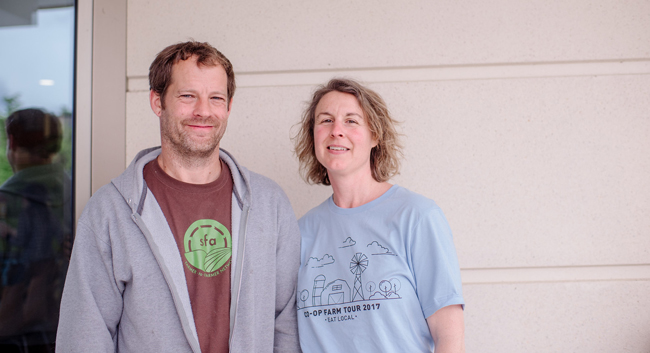
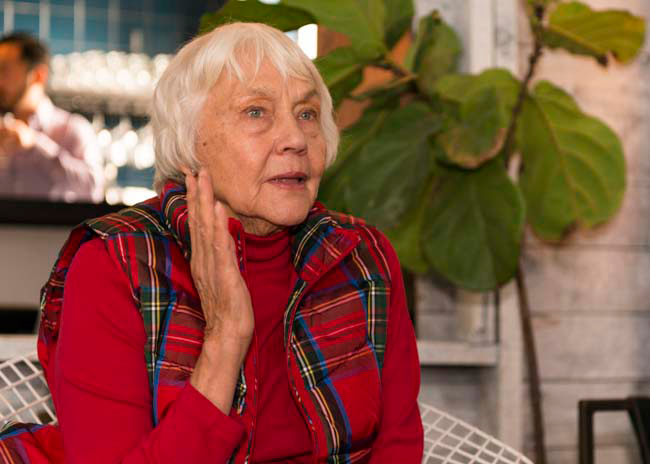
Three or four years ago, Vivienne Whitfield (above, left, with Marta Feder) ate like a pretty typical young professional: lots of takeout, lots of microwave dinners. She hadn’t cooked much since she was a teenager and her mother kicked her out of the kitchen for some pretty typical teenage slovenliness.
Then, as they say, a baby changed everything. Pregnant with her first child, she was sick every day for nine months and found she simply couldn’t stomach processed food. “If I wanted ketchup,” she says, “it had to be homemade ketchup.” That and an eye-opening viewing of Food, Inc. led Whitfield back into the kitchen and eventually to the aisles of the Linden Hills Co-op — and into a whole world of food she had never paid much attention to before.
She spent a year reteaching herself to cook, pulling out her South African gran’s cookbooks from 30-plus years ago, to make bobotie — ground meat seasoned with cumin, coriander, and raisins — and butternut soup. She got hooked on the homey simplicity of Jamie Oliver and Nigella Lawson. She mixed hearty vegetarian meals like cauliflower with chickpeas with updated versions of classics like shepherd’s pie.
For a year, Whitfield tested all these recipes out on her husband Paul and their now-two-year-old son. And now she cooks them for other people, mostly new parents, but also people undergoing cancer treatment and others who just appreciate having a home-cooked meal show up on their doorstep once a week.
Whitfield founded her organic meal delivery service, Liv with Viv, a year ago, and now how has dozens of steady customers. She emails each week’s menu — this week the choices are chickpea and sweet potato soup and linguine with artichokes, with either salad or pumpkin scones — each Monday. Customers place their orders by Friday. Whitfield cooks all day Sunday and her husband drops the meals off Sunday night. (And, in the meantime, she works Monday through Friday at Best Buy, in digital analytics.)
Working two jobs and raising a family can be grueling, but Whitfield says she finds the extra weekend and evening work more than worthwhile. “I’m an entrepreneur at heart,” she says.
The recent appearance of new incubator kitchens has made it possible for tiny food businesses like Liv with Viv to get on their feet. Whitfield achieved her food manager certification and set up her business with the help of Kindred Kitchen and now cooks at Kitchen in the Market, alongside the folks from Dandelion Kitchen.
For the first six months, all of her customers were friends or friends of friends. Then she left a few business cards at Blooma, an Edina yoga studio focused on pregnant women and new mothers. Not surprisingly, new parents jumped at the chance to outsource some of the cooking. Some put meal delivery on their baby shower wishlists. Many of those customers have stayed on past the tiny-baby stage, and another audience has found Liv with Viv, as well. Continue reading Vivienne Whitfield of Liv with Viv »

Courtesy of MNHS Press
“Even an experienced fisherman, seeing swallows swarming above the stream, and fish rising avidly, can fail to perceive what all the fuss is about until he crouches to examine the river’s surface. There he will see a flotilla of lilliputian sailboats, the mayflies with their wings erect, actually standing on the surface film, their wee feet dimpling the surface.”
Since 2008, Brett Laidlaw’s blog Trout Caviar has allowed us to tag along on his bucolic ambles, foraging through woods, streams, cheese shops, and farmers markets and, almost always, emerging with the ingredients for a fine meal. (Indeed, the sentences quoted above lead to a brown trout, the anchor in a cold supper of salad, chevre, and artisanal bread.)
Laidlaw’s poetic descriptions of life in his primitive, Wisconsin cabin, Bide-A-Wee, and the food-laden fields and streams that surround it, cast him as a mash-up of Thoreau and a kind of forager’s Julia Child. He is equal parts nature and food writer. And, though he often writes of farm-grown and locally produced foods, his blog makes wild foods less intimidating by identifying the rare or long-forgotten sorrel, honey mushrooms, and chokecherries and using them in tasty yet not too precious recipes.
Fans of the blog will be pleased to discover that Laidlaw’s new book, Trout Caviar: Recipes from a Northern Forager (261 pages, $27.95), is equally delightful to read and packed with anecdotes and recipes, many of which are brand new.
Here he talks about the new book, sustainable foraging, the joys of shopping — and how, contrary to popular belief, most of nature is edible. Plus, he gives us the recipe for his reconstructed coleslaw.
THE HEAVY TABLE: You take a pretty broad view of foraging – can you explain your philosophy?
BRETT LAIDLAW: That’s sort of the theme of the whole book, I think there’s a lot of interest in wild foraged foods lately, and I’ve done that for a long time, but I don’t eat that way exclusively and I doubt that many people do. So, I wanted to make the book more accessible, but also to stress the importance of getting really good ingredients wherever they come from.
HT: In the blog, I get the impression that you kind of scurry about, over the course of your day, popping over here for this or there for that – sort of gathering ingredients.
BL: In my shopping and foraging, I’ve gotten to the point where I rarely set foot in a big grocery store – you know, I’ll buy paper towels and toilet paper, and that’s about it. So it’s the co-op, farmers markets, the garden, and smaller shops, like Clancey’s or a cheese shop. I say in the introduction that 90 percent of good cooking is good shopping, taking shopping in a very broad sense of getting the best local, seasonal ingredients and doing the best that you can by them. I don’t mind spending a lot of time gathering the ingredients of meal because it’s a pleasure to pop into Clancey’s and see what crazy cuts of meat they’ve got in — and I get really inspired to cook through that, too.

Brett Laidlaw
HT: It’s a different model of shopping – you know, get what you feel like eating and what looks good, rather than cramming all of your shopping into one giant store, one day a week.
BL: It’s a bit like the French market model. Unfortunately things are maybe more spread out around here, so there’s often driving involved. It would be nice if, you know, we lived on the left bank and you could just go out with your string bag and hit the charcuterie, the cheese shop, and the market and bring it all home in the course of a nice walk. You can kind of do that at the farmers markets here. I’ve really been enjoying going down to the Minneapolis Lyndale market on weekdays this summer. It’s not a full scale market; there’s not a lot of meat, but you can get all the vegetables you want and it’s a much more mellow scene than on the weekends.
HT: In the book, you write vividly of fishing and picking wild blueberries as a kid, but how did you become comfortable with foraging for the more wild and oft hard to recognize stuff – mushrooms, in particular?
Continue reading Brett Laidlaw Talks About Trout Caviar — the Book »

Dan Norman
I was recently introduced to a local celebrity, a friend of a friend, who said we’d have a lot in common. This sort of thing happens to all of us — sometimes it works out, sometimes it doesn’t — but when the friend in question turns out to be a pig, one feels more than the usual amount of stranger aversion. What could we possibly have to talk about? Pretty much oink.
Of course, it never pays to make assumptions. I knew in one glance that Mercy Watson, the curly-tailed heroine of local author Kate DiCamillo’s charming children’s book series, would be a lifelong friend. It didn’t take us long to discover that we have but one thing in common: an uncommon love of hot, buttered toast. In these carbophobic times, one longs to meet a fellow traveler. Ah but for one frustrating moment it seemed we were doomed to sit, nose to snout, all our best adventures, our most glutenous hopes and dreams, ready to pour forth — yet silenced for lack of a common language.
Not surprisingly, Mercy, the porcine wonder, knows a pig-whisperer. Victoria Stewart was the playwright for Mercy Watson to the Rescue, which is playing at Children’s Theatre Company now through October 23. The play is a stirring roman á clef: Mercy heroically saves many lives, including those of her parents, Mr. and Mrs. Watson, and makes unlikely allies of the fireman, animal control, and a rather curmudgeonly neighbor — all in the name of toast.
Here, in our brief discussion via Victoria Stewart, Mercy reveals a more contemplative side, gamely talking about literary heroes, the horrors of vegemite and lost toasters, and the upside of cold, dry toast.
HEAVY TABLE: How did you discover your love of toast — of all the tasty snacks?
MERCY WATSON: I used to eat pretty much anything I could find with my very sensitive snout, nuts, berries, mushrooms, grubs. But the Watsons introduced me to toast — Mr. Watson likes a lumberjack special — and it was love at first sight. The Watsons fell in love with me and I fell in love with toast. Continue reading Mercy Watson: The Porcine Wonder Talks Toast »

Natalie Champa Jennings / Heavy Table
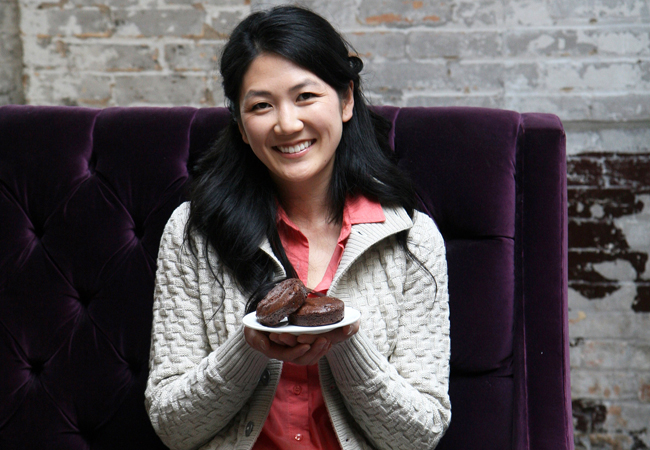
When Anne Rucker heard the news that she would be selling her desserts at the Kingfield and Fulton farmers markets in Minneapolis, she realized that she had no real plan of action. She would be baking out of her home kitchen and had to produce enough to feed… well, she wasn’t actually sure how many desserts she needed to bake.

Natalie Champa Jennings / Heavy Table
And then she learned that she would be sharing market space with the respected Sun Street Breads and Patisserie 46. Her reaction was not calm. “I was like uh-oh. How will I do this?”
The first few weeks were tough, though Rucker oozes enthusiasm and confidence, so market customers likely had no idea. The truth is that on those first Saturday mornings, she probably hadn’t slept at all the night before and was nursing swollen ankles and an aching back from hours of baking. Immediately after the markets closed, she would unwind with her husband and a glass of wine before collapsing, completely and utterly exhausted.
Single-handedly producing enough goods for a market stand would be a struggle for anyone. But in Rucker’s case, she also was dealing with the inconvenience of mass producing items from a standard home kitchen and without any prior professional experience.
She still made it to market every week, however, with desserts in tow and a smile on her face. Smiling for good reason, she says, “The community has embraced me, and it’s been amazing. I feel like the luckiest girl in the world.”

Natalie Champa Jennings / Heavy Table
Rucker’s doughnuts are gaining attention (for example, she’ll be at this Friday’s North Coast Nosh). Rightfully so, too. They range in variety from Nutella-filled to vanilla bean-glazed to brown butter-glazed to the more adventurous maple bacon. The doughnuts are happily not just one big sugar bomb, but instead a lovely balance of fluffiness and substance. Her brioche dough makes for a delightfully rich doughnut — brioche is made with a lot of butter and eggs. And since it’s a yeasted dough, the doughnuts have a full, almost nutty taste. “The richer the better,” she says. Continue reading Anne Rucker of Bogart Loves Bakery »

Courtesy Granny's Kitchen Fudge Puppies
Food lovers who spend 353 days of the year dreaming of their gorge-worthy favorites available during the 12-day run of the State Fair, wake up and smell the coffee.
The new Turkey To Go truck sells those mouth-watering sandwiches on the street, and the Chef Shack can cure your mini-doughnut craving. Sweet Martha’s cookies, in frozen, bite-size, oven-ready globs, can be found in most groceries. Deep-fried cheese curds are on the menu at burger joints ranging from The Blue Door to The Bulldog to Culver’s.
And soon, you will be able to enjoy a fudge puppy without waiting for the dog days of summer. “People are already telling me they plan to throw fudge puppy parties,” says Pat Braun, who brought the chocolate covered Belgian-waffle — on a stick, of course — to the State Fair. Starting October 1, puppy lovers will be able to get the treat online. Braun will accumulate orders for a few weeks and then will get busy in a commercial kitchen she’s renting in Blaine. Continue reading Pat Braun of Granny’s Kitchen Fudge Puppies »

Natalie Champa Jennings / Heavy Table
The East African Bakery was introduced to us anecdotally. A food scientist we know had just put in several very early mornings at the wholesale bakery, helping Ethiopian entrepreneur and owner Francesco O’Ryan improve his injera and hambasha formulas. He waxed poetic about the injera’s beautiful cell structure and mahogany hue and hinted that there was a good story behind the fellow’s name, but what captured our imagination was a side note — the baker had invented his own injera-making machine. Somehow, this reminded us of Professor Potts in Chitty Chitty Bang Bang, and so we made an appointment to go to the bakery, fully expecting to see a wondrous contraption, all cogs and pistons, billowing smoke and sending injera spinning over our heads.
East African Bakery is tucked behind a non-descript furniture store on University Avenue. Inside it has all the ambiance of a tidy warehouse, but what it lacks in sunlight it makes up for with the toasty sweet smells of coffee and baking hambasha. The day we visited, O’Ryan greeted us with cups of Ethiopian Sidamo, which he had just roasted and brewed on a hot plate at the back of the bakery. It was smooth and light and tasted of chocolate and fruit, and drinking it made our 6:30am interview a bit more lively. A short tour of the bakery revealed the injera maker, which was not a fantastic gadget at all, but instead an elegant machine. Unfortunately, the machine is not pictured here — the patent is still pending. But, imagine a large, gleaming steel box encircled by 12 industrial hot plates with stainless steel lids, every one of them wide open, like big metal muppets waiting to receive communion wafers. It turns out that O’Ryan is a gifted machinist turned baker, rather than the other way around.

Natalie Champa Jennings / Heavy Table
O’Ryan was born in Asmara, Eritrea. His Ethiopian mother raised him; his father, an Irish American, left Asmara and returned home when O’Ryan was still an infant. Serendipitously, twenty years later, his mother was invited to a coffee ceremony — a formal event that can last several hours — with a man she’d never met, but who turned out to be her former boyfriend’s new father in-law. O’Ryan contacted his father and moved to the United States just days before his 21st birthday. “I was lucky to find my dad that way,” he says. “Otherwise, I might have been one of those people who comes on foot or worse — I’d have been the person you read about; a boat sinking on the way to Italy. Most people from East Africa get out that way.”
Instead, O’Ryan landed in Minnesota. From the age of 13, he had worked in machine shops — “I was always into machines,” he says — so he attended St. Paul College, where he earned a technical degree in machining. Afterwards, he took a job at a company that primarily built specialized machines for 3M, but allowed employees to work on their own projects in the off hours. In 2000, O’Ryan started toying with the idea of a project: “I had always wanted to build some kind of machine of my own,” he says. “So while most people were building robots, remote-controlled cars, and bow guns, I was working on a hot plate.”
O’Ryan jokes, but making injera at home is a real challenge for Ethiopians in the United States — much less mass producing it.
Injera is a round, flat bread that looks something like a thick, spongy crepe and has a nutty, slightly sour flavor. It is eaten at nearly every meal in Ethiopia, where sauces and stews are served on top of it, so that their juices soak into the bread’s copious nooks and crannies. Smaller pieces of injera are used in place of silverware to wrap up bite-size morsels and neatly convey them to the mouth.

Natalie Champa Jennings / Heavy Table
Traditionally, injera is made from teff or a blend of teff, barley, or wheat. Teff is native to Ethiopia, dating back to 4000 BCE, and is only grown in limited quantities outside of Africa, which makes it expensive elsewhere ($1.28 a pound, compared to wheat at $.05 a pound). Although allegedly the world’s smallest grain, it is a veritable super food: It’s gluten free; high in protein, carbohydrates, fiber, and various and sundry minerals; and, due to its diminutive size, it cooks quickly, which is handy if you have to produce dozens of injera each week.
“Making injera at home, the way I grew up, is a hideous process,” says O’Ryan. Using an injera-starter, rather than yeast, the batter is mixed by hand and then ferments for a week. During that time, it takes on a life of its own. One day, a batter may produce a nice bubble; the next, even if the baker mixes everything precisely the same way, she will get a different result — anything can throw it off, so bakers are constantly making trouble-shooting adjustments to their batter. Once it has fermented, the batter is baked over a wood fire on a huge, clay, hot plate. “It’s very smoky and they can only make one at a time. So, my mom would spend half a day making injera and only produce three or four days worth.”
Here in the US, O’Ryan says, home cooks use electric hot plates, but they tend to be poorly made, providing too little and generally inconsistent heat and burning out under the stress of regular use. It’s simply easier to buy injera. Unfortunately, most manufacturers are using the same hot plates, which makes it difficult to manually produce a lot of injera and well-nigh impossible to consistently create high-quality injera. Continue reading Francesco O’Ryan of East African Bakery »


Recent Comments