A fairly amazing-sounding Better Beer Society brown bag series event at Butcher & the Boar, some revised menus at local restaurants, a local foodie’s epic Mother’s Day feast, tasting notes for Summit Pilsner and Steel Toe’s Provider, the Star Tribune’s Taste 50, and a new urban farm in Minneapolis.

Tricia Cornell / Heavy Table
There’s a certain kind of cook who, having mastered stir fries and crepes and béchamel and whatnot, starts staring into the fridge and the pantry and the excesses of the grocery list and asking, “What else could I make?” Mayonnaise, though tasty, hardly proves a challenge. Ketchup, it turns out, isn’t worth it.
Inevitably, this restless cook’s eye falls on the cheese drawer: All those dairy products are just milk at the core, right? I could totally do that. And those are the sorts of folks who find their way to Wind Dance Vineyard and order a cheese kit, or two, or three.
Wind Dance’s owner, Bob Belbeck, was once that restless cook, himself. But, first, he was an almost accidental viticulturalist. Finding he had a few spare acres near his home in Delano, MN, he planted grapes and sold the juice to nearby wineries. Thus the vineyard was born. The vineyard became a cheesemaker’s shop about 20 years ago when Belbeck started experimenting with cheese and found it hard to buy supplies in small amounts. He started selling kits online and in a few select stores and now has a line of kits for six kinds of cheese, along with presses, molds, and cultures.
Belbeck says he can usually tell who is going to turn into a regular customer. These are the folks whose first order is the Parmesan kit (most people, wary of the aging process or looking for a quick cheese fix, go for the mozzarella). Parmesan is Belbeck’s favorite and, he says, the easiest to start with because it calls for two-percent milk (when making cheese with two-percent, Belbeck says he can buy any old milk off the shelf, but finding a whole milk that will work is trickier). Then, about six months after that first order — meaning immediately after that customer has had his or her first taste of homemade Parmesan — he gets another order. They’re hooked.
“All of our [store-bought] cheeses now taste processed, once you tasted real cheese. It’s like wine: If you’re going to have it, you might as well have some of the good stuff,” Belbeck says. He now makes nearly all the cheese he and his wife eat. “Good Parmesan costs $18 a pound. I can make two pounds for $8 or $10 and it tastes better. A lot of the Parmesan in the store doesn’t taste like it’s aged at all.” Continue reading Making Your Own Cheese With Wind Dance Vineyards Cheese Kits »

Kate NG Sommers / Heavy Table
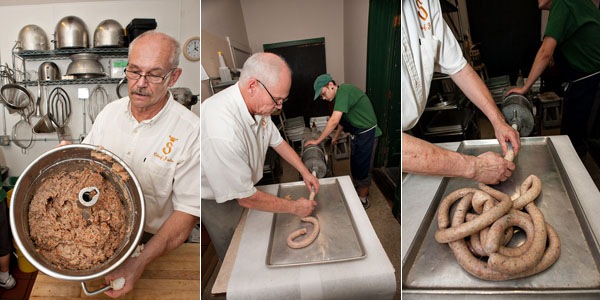
As if Mother Nature knew the turn in seasons was upon her, the Labor Day holiday came and brought with it a sudden drop in temperature. For the home chef, this chilly fall weather suggests meals that are heartier than the summer tomato salads and chilled sliced cucumbers made using produce spilling out of our gardens. It means belly-warming meals like steaming soup, chili, or if you’re in the mood for a traditional Czech or German treat, homemade sausage. Chef John Schumacher of Grill 212 in New Prague welcomed the Heavy Table into his kitchen to show us how he prepares his classic Hotel White Sausage — stuffed with pheasant, chicken, and turkey. (The dish is available on the menu as an appetizer for $7 or a sandwich for $10.) Below are a few tips from – cue Ferris Bueller reference – one of the Abe Fromans of Minnesota.
Treat Spices Right
You can really use anything in your sausage. If pleasing your palate means cinnamon or juniper berries, go for it. Schumacher uses nutmeg, fennel, and dried chives in his Hotel White Sausage. If you are using whole spices, though, he recommends baking them prior to grinding. The oils in whole spices retreat to the center, but you can coax them out and distribute them evenly with heat.

Kate NG Sommers / Heavy Table
Moisture is Key
Throughout the process, Schumacher reminds us of how he salvages moisture. For example, he only uses certain parts of the pheasant – like the thighs, legs, and skin – and doesn’t use the breast. This recipe calls for two parts chicken, one part turkey, and one part pheasant. He doesn’t use as much pheasant because it would be drying. He uses fresh breadcrumbs rather than dried. Schumacher uses whole wheat for this recipe, but you can change it up by replacing whole wheat with rye or sourdough. “A lot of people make the mistake of using dry breadcrumbs, and when they’re cooking the sausage it burns,” he says. He also incorporates heavy cream into the sausage mixture, which not only adds moisture but also acts as a binding agent and distributes the fat evenly. Continue reading Sausage Making Tips with John Schumacher of Grill 212 in New Prague »
In Bavaria every baby’s first food is a pretzel, says Stefanie Völlinger. While they gum the thick, smooth, dark brown crust and dense, chewy interior of a Bavarian pretzel, they are getting the first taste of food traditions that go back centuries and that their families and neighbors, for the most part, take very, very seriously.
Okay, that last part is me editorializing, not Stefanie, who is spending the year in Minneapolis as an au pair. Like most Germans I’ve met, she has strong opinions on food, especially baked goods. Hailing from Augsburg, she has particularly strong opinions on pretzels. “We care a lot about our pretzels in Bavaria,” she says. “In other parts of Germany, they don’t care.”
I’ve formed some opinions on pretzels, myself.
My older sister made the most of five years in Germany courtesy of the US Army by educating herself on German wines and German baked goods. During a handful of visits I took advantage of her hard-won knowledge and was happy to be ahead of the curve when everybody started drinking grüner veltliner a few years back. But the food memory that stuck with me, and the one that still makes my sister say, “I need that now,” is the pretzel croissant.
She discovered it in the bakeries of the first small Bavarian town she lived in, but after a move to another small town on the other side of Frankfurt, her requests for a “Laugencroissant” were met with blank stares that had nothing to do with her accent.

Katie Cannon / Heavy Table
The pronunciation of the word ibrik (eeh-breek) is one of the biggest reasons why people shy away from using it to brew coffee. Also called a Cezve (jez-veh), the ibrik is designed to brew Turkish-style coffee. You can still find this old-fashioned brewing implement in active service — cafes including Cahoots Coffee Bar and Shish Cafe in St. Paul brew with ibriks. The simplicity of the ibrik reflects the origins of coffee brewing, delivering a cup where sediment is appreciated and the addition of sugar and spice adds to the balance and experience of the cup.
Holy Land Bakery and Deli carries a selection of different size ibriks along with cardamon and other Turkish spices. Although Turkish coffee can be made without the addition of sugar or spices, the sugar adds not only to the taste, but also the texture of the cup, while the cardamon helps to mellow the acidity. Prior to modern roasting techniques and green coffee growing improvements, coffee was an astringent and bitter beverage that needed the tempering influence of other flavors so that it could be enjoyed.
Brewing with an ibrik differs from other brewing methods like French Press and Pour Over Brewer because the water is brought to a boil, while most other brewing methods perform best at temperatures between 195 and 205° F. The ibrik is filled most of the way full with water and fresh, finely ground coffee. Cardamom, sugar, or other spices can also be added. The contents of the ibrik should not be stirred and space should be left near the top to allow for bubbling when boiling. Not stirring is important so that the ibrik may naturally create a crust that will harden and prevent grounds from being transferred to the cup.

Katie Cannon / Heavy Table
The grind of the coffee is the finest grind of any other brewing methods, including espresso. Coffee should be ground to the texture of a powder so that it can dissolve and add to the texture of the cup, since there is no filter involved in the brewing process. A coffee to water ratio of 14.5 grams for every eight ounces of water (as suggested by the Specialty Coffee Association of America) should still be used as an initial measurement. As you become more proficient with the brewing method you can use more or less coffee, depending on personal taste.
After the coffee and other ingredients are added to the water, place the ibrik over medium heat and bring to a boil. Grounds will begin to moisten, and when the water begins to boil, remove the ibrik from the heat. Allow it to cool for at least one minute before returning to heat. The ibrik should be brought to a boil at least two more times.
After the third boil, coffee should be slowly poured into preheated demitasse cups. Slowly pouring the coffee will allow the grounds to catch at the rim of the ibrik, preventing most of them from being transferred to the cup. Some grounds will naturally end up in the cup, adding a thicker, grittier texture that is common and appreciated in Turkish coffee.
At Cahoots Coffee in St. Paul, owner Saed Kakish from Jordan creates his own special blend of spices for his Turkish coffee. Experimenting with various coffees, spices, and sugar will allow you to create the cup that you find the most satisfying. It is a brewing method that is far from the low acid taste of a French press or the clean taste of a pour-over brewer. It is a unique brewing process that allows texture, sugar, and spice to be appreciated.
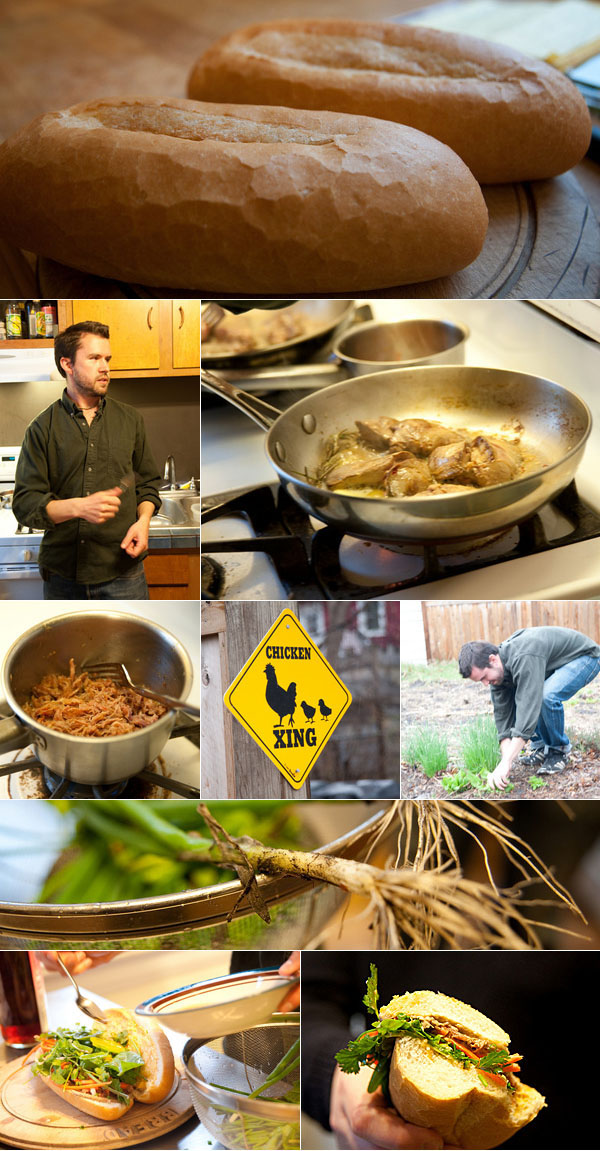
The Heavy Table’s James Norton visits with The Perennial Plate‘s Daniel Klein to make a Vietnamese Banh Mi sandwich. Edited by Daniel Klein, filmed by Cully Gallagher, and music by Lucy Michelle and the Velvet Lapelles: “Special Party Time for Everybody.”
Banh Mi
Duck (or chicken) liver pate
8 duck (12 chicken) livers
2 c milk
salt
1 tbsp grapeseed oil
1 small onion
1 stick of butter (4 oz) or more depending on how livery you want your pate
3 sprigs of rosemary
1 c cream
½ c white wine
salt to taste
Continue reading How to Make a Banh Mi Sandwich »
Cake, for some, has always been a take-it-or-leave-it kind of thing — once you’ve had a few church basement birthday, anniversary, or graduation party sheet cakes, the dessert seems a bit less enticing and a bit more blah. There is one cake, however, that never fails to impress.
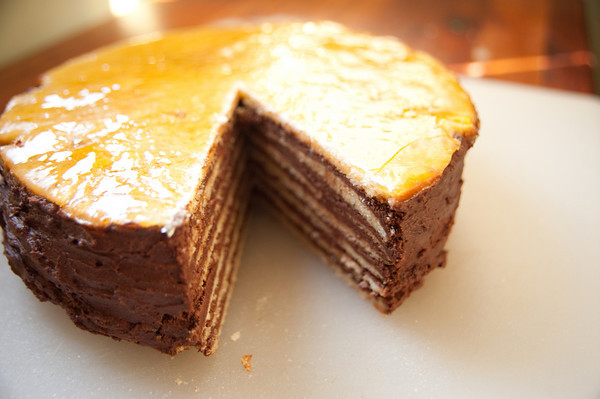
At the house of a Serbian family friend, one cake seems always to be present for special occasions. The cake, called a dobosh torte (drum torte), is the stuff of dreams — countless layers of wafer-thin vanilla cake piled high with chocolate mousse in between, all topped with a hard, transparent caramel “glass.” The crunch of the caramel combined with the smooth filling and chewy cake comprise an elegant array of textures, while the layers provide a nicely distributed contrast between rich chocolate and light vanilla. Despite many requests for the recipe, we’ve been told it’s “too much work — have bubba [the grandmother, who produced the glorious cake] make it for you!”
So begins a quest for the perfect cake. Numerous recipes exist on the Internet, all loosely based on Hungarian Jozsef Dobos’ original recipe. Our attempt drew from two such recipes: the first, from About.com’s Eastern European Food section, relies on a pound and a half of butter as its main ingredient. The second, from Food & Wine magazine, was a bit more egg-heavy and added lemon zest to the cake batter. The first tasted a bit drier and had a mouthfeel which seemed, if baked long enough, to tend toward biscotti; the Food & Wine recipe was spongy, if a bit overly eggy, and produced a lighter-textured cake. We settled on the butter-laden recipe; the slightly tougher, drier texture stood up well to the smooth mousse.
We then tested two methods for creating the layers: baking each über-thin layer separately, or creating a thicker cake layer which would be sliced thinly when cool. A non-stick springform pan (if you don’t have one and want one on the cheap, Target carries them for around $10) made the job foolproof; we also tested both non-stick cake pans and disposable aluminum cake pans. Though individual layers were incredibly easy to produce without fail, they yielded the tougher crust created when raw batter is exposed directly to heat. Sliced layers were a bit more tender, and the time-saver of baking several layers all at once was a serious perk. However, the slicing option carries with it a caveat — slice one crooked, and you run the risk of a lopsided cake. Try to fix it, and you get a crumbly mess.
The buttercream, in essence, is a no-brainer: a pound of butter, lots of high-quality chocolate, and several egg whites whipped to stiff peaks. This one’s far, far easier with an electric mixer — using a simple hand-crank mixer, the egg whites will not whip in any reasonable amount of time once they’ve been heated and nearly saturated with sugar (trust us — we tried it). If you don’t have access to an electric mixer, add the sugar to the melted chocolate while it’s still hot so it can dissolve — then whip the raw egg whites separately and fold them into the chocolate-butter-sugar mixture. The frosting will still be light, you’ll still get an arm workout, and you will still have the desire to cook again someday.
The caramel glass is the final tricky step. If you’ve made crème caramel before, it’s the same process: Swirl some sugar and water in a pan, wipe the sides with a damp cloth to remove crystallized sugar (which destroys the clear, glass-like effect you’re shooting for), and pour. Parchment paper, laid liberally around the cake layer you’re topping with caramel, minimizes the mess that spilled, hard-as-glass caramel can create. The parchment paper doubles functionally as a moveable surface: Drizzle the caramel onto the cake, then tilt the parchment and cake to distribute the caramel without leaving unsightly spatula-shaped imprints from manual caramel-spreading. Continue reading Dobosh Torte »


Recent Comments