
These stories about Razava Bread Company come from the July 10, 2026 edition of the Heavy Table Substack newsletter and are written by Eli Radtke (bagels) and Stacy Brooks (porridge bread).
BAGEL NOUVEAU
Razava Bread Company of Saint Paul isn’t making New York bagels or Montreal bagels; it’s making Razava Bagels.
By Eli Radtke
What makes a bagel?
This is a question that has troubled the dreams of bakers, bikers, businessfolk and baristas the world over. From coast to coast, country to country, everyone has a say about what a bagel should be.
A NAME CHANGE
Razava Bread Co., located on Grand Avenue in St. Paul, set out a year and a half ago to answer that question. Razava opened with the motto “Old world bread for the new world”, using long-ferment techniques and hearty grains in their breads. One crucial addition to that menu, though, was the New York Bagel.
“We didn’t feel that it would be a complete menu without a bagel on it,” says Alex Baldinger, Razava’s Brand and Operations manager. “In the Jewish community, bagels are the source of happiness, sadness, and gratitude, just because; bagels are what you turn to.”
Now everyone has their specific order, and their own stipulations around how and what makes their favorite bagel. (With the Knicks winning the NBA finals, the sausage egg and cheese has never had more of a moment on social media outside of a NY Bodega). The golden standard is the glossy, golden brown halo that you can knock on like a wood block and break open to chewy, dense and steamy dough. (At least when we talk about New York style).

While these are the bagels that inspired the idea at Razava, the process of making the old world bread with a long ferment style led to a different take on the classic bagel. Looking at their product, Razava realized they had created an entirely new take on a bagel that didn’t fit the New York moniker, and so the menu changed from a New York Bagel to the Razava Bagel.
A SAINT PAUL STORY
This old-world style comes from a fusion of deep St. Paul pedigree and a passion for doing bread the slow way and developing flavors. The first comes from the Baldinger family itself. Steve Baldinger, the founder of Razava bread, is the great-grandson of Henry Baldinger, who opened a bakery a mile away from Razava’s current location in 1888. The Baldinger bread business went on to grow and move towards a more commercial angle, but Steve wanted to bring artisan bread back to the neighborhood where it all started.
The long-fermentation mindset came with the addition of Omri Zin-Tamir, the founding baker at Razava. Zin-Tamir had set up a long-fermentation bakery out of his St. Paul home, experimenting with high-hydration and flavors, and making waves at local markets. Combining Zin-Tamir’s passion for making the Twin Cities a bread destination and the Baldinger bread legacy, Razava opened its doors, and started taking great grains and turning them into great breads.
A BRAND NEW WAY TO BAGEL
So what makes these bagels so different from their East Coast cousins that they needed a name change? First and foremost: the look.
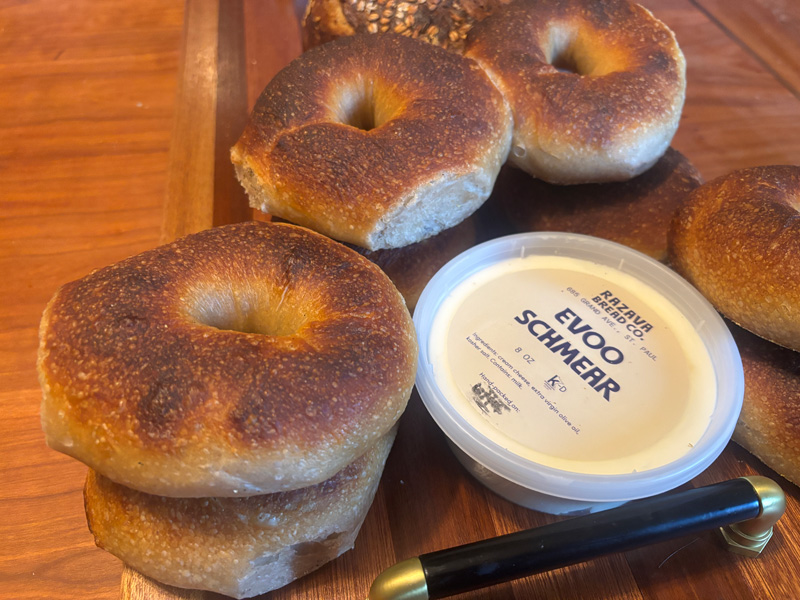
The Razava bagel is a much darker bagel by far than even some of the darkest bagels you could find at a bodega. While a traditional New York style bagel has a gloss to it, the Razava bagel has a more rustic, bubbled and sourdough-like exterior. It may look like it has been in the oven too long, but this color is flavor. The Maillard reaction creates a deep caramelization on the outside of the bread, much like a sourdough loaf, giving the crust flavor and crunch.
“We’ve all had those bagels that are too pale, like they have seen a ghost,” jokes Alex Baldinger. “We lean into the flavor of the caramelization; you’re leaving flavor and texture on the table if you don’t bake dark.”
The differences are more than crust-deep, though. Traditional New York Bagel doughs are usually created at 50 – 55% hydration (meaning the amount of water relative to the amount of flour in the dough), with 60% being nearly unheard of. This is to keep the bagel’s dense crumb and the dough workable. Any more hydration and the dough would become too soupy to hold shape.
Razava’s bagels come in at around 75% hydration, much nearer a sourdough or even closing in on a focaccia than traditional bagels.
This is made possible by a process called Tangzhong. Zin-Tamir says that Razava uses a scald method in which the flour is pre-boiled, gelatinizing some of the starches. This Tangzhong process allows for more water to be absorbed into the flour, without the dough becoming too sticky to work with. The process is commonly used in Japanese baking, specifically with milk breads.
Another difference is when the bread is shaped. In a traditional New York Bagel spot, fridges are stacked sky-high with bagels that have been shaped and then bulk-fermented in the cold. Razava does the opposite, choosing to mix the dough and let the bulk fermentation happen before it is shaped, rather than after. This also helps to save space, so that there doesn’t need to be an entire fridge just dedicated to bagels.
Finally, once they are shaped, they go into the water for a boil, right? Not Razava. With the high moisture content of the dough and the use of a steam oven, Razava skips the dunk in the bagel kettle that is synonymous with New York-style bagels.
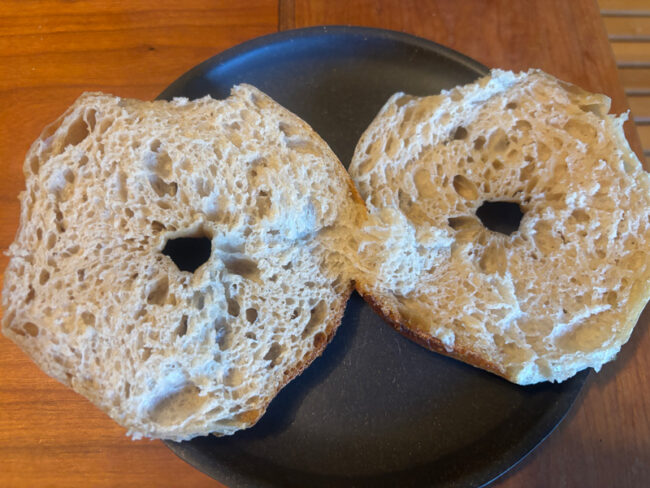
All of these changes set the Razava bagel apart from the New York bagel. When the flour settles and the steam cools off, cracking open the Razava bagel, it’s clear to see where the chemistry has made a difference. The inside of the bagel is still tight enough for schmears and toppings, but has larger and more crystalline-like bubbles, like a smaller sourdough. The bagel itself is much lighter than a traditional New York bagel, with more of a forgiving “squish” from the crumb than the hard-packed chewiness present in others.
The taste itself is as different as you would expect. For options, the smoked salmon bagel comes in half (14$) or two halves (19$), and the regular bagel with schmear is $5.25. Biting in, the malty, yeasty flavors that everyone knows and loves are still present, but a pleasant floral note comes through with the tang of the longer ferment. The interior is moist without being gummy, and the crumb is solid enough to pile on a smear and desired toppings. The salmon sandwich, served open-faced, was a fantastic bite, with the tang of the sourdough really complementing the buttery notes of the salmon and the tartness of the onions and caper schmear.
While being slightly on the expensive side for two halves, the sandwich was incredibly filling without causing you to feel like your whole day was over before 10. The star of the show is the fresh bagel, but the caper cream cheese and bright, fresh ingredients were refreshing and made it feel like a full meal versus just eating rings out of a bag on the corner.
A BAGEL FOR THE FUTURE
Baldinger says that in the future, they hope to continue expanding both their offerings and their hours, but want to make sure quality doesn’t get in the way of expansion. “We want this to be a neighborhood destination.”
Both Baldinger and Zin-Tamir expressed their passion for the process. With the Twin Cities being such a historic city for flour and grain, Razava truly wants to highlight that offering and the high-quality ingredients through the long ferments.
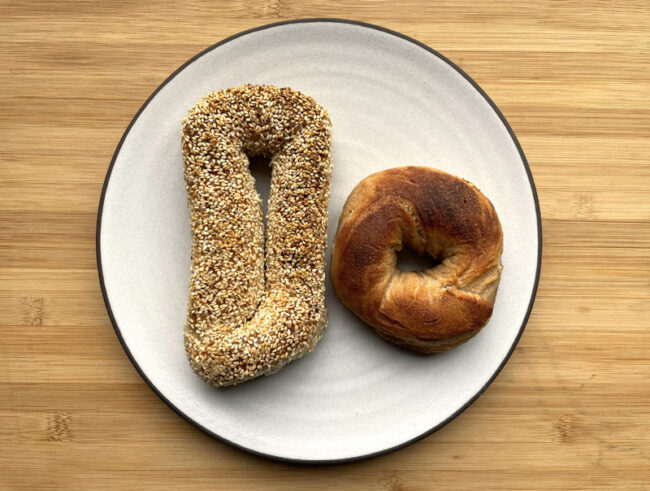
Another featured item on the menu, the Jerusalem bagel, more closely reflects a bagel Zin-Tamir remembers from his childhood. Both this bagel and the Razava bagel pay their homage to the New York style while capturing a specific new flavor that is unique to the place it is made. It is exciting to see unique styles arise, especially in an arena where the coasts so heavily dominate. When asked, Baldinger said this about what he hopes that those that visit Razava for the bagel take away:
“I hope they think ‘Wow I didn’t know bread could taste this good.’ I want them to feel like they did something good for themselves, not just that it’s carbs.”
Razava Bread Co., 685 Grand Ave, St Paul, 763.338.0853, WED-SAT 7am-4pm SUN 8am-3pm
CHEW ON THIS
Grain is the key to bread, and Razava’s porridge bread doubles down on that idea.
By Stacy Brooks
When I interviewed Omri Zin-Tamir back in 2022 about his home-based The Bakery on 22nd Street, I was struck by his passion for flavorful bread, which he crafted by emphasizing heritage grains through natural leavening and long fermentation. I’ve always loved bread, maybe because I was fortunate to grow up in a home with plenty of homemade loaves. But Zin-Tamir gave me a framework for more fully appreciating bread’s potential, and his vision for making nutritious, flavorful bread more accessible is something that I’ve often reflected on in the years since.
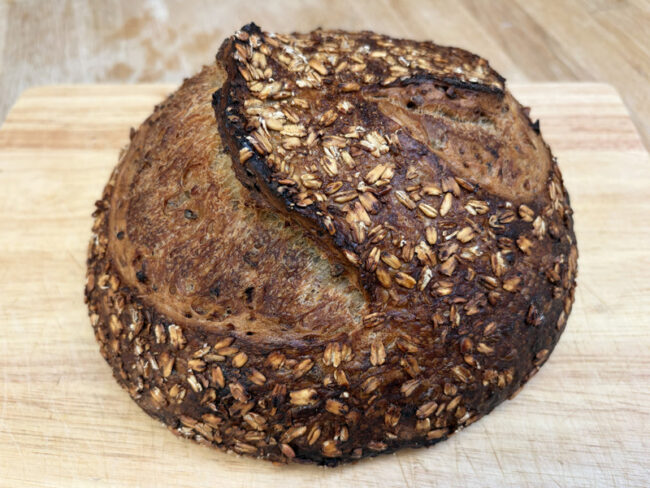
Zin-Tamir has since moved on to a role as the founding baker of St. Paul’s Razava Bread Co., sharing his grain-focused approach with a broader audience. Perhaps no loaf encapsulates that philosophy better than the bakery’s popular porridge bread, although when it launched last summer it was initially a bit of a hard sell.
“We had to put out samples at first, just to make sure people knew that they’re not buying a bowl of porridge that looks like bread,” says Zin-Tamir with a chuckle. “It’s actually bread. It’s just very flavorful, and the porridge even makes the crumb super moist and tender. I don’t know how, word of mouth, or just more and more people became really excited by it, but it’s become really popular, one of our most popular, best selling breads, which we’re very proud of.”
Zin-Tamir first encountered porridge bread in Chad Robertson’s Tartine Book Number 3. “Just the idea of it really inspired me,” he recalls. “You know how they do different forms of rice? They do rice rolled in a rice paper with rice noodles, promoting this ingredient in many different ways in the same dish. I love it when they do that, that you can somehow use the same ingredient in different ways and roll it up into a single thing, and then it just gets to become more of itself.”
Razava’s porridge bread becomes more of itself thanks to two separate components: a base dough, which is the same as the bakery’s San Francisco sourdough; and a porridge made from kamut, emmer, einkorn, and oats.
“There’s no real high philosophy about why those grains specifically, it is just a combination that we found is flavorful, that incorporates a lot of different ancient grains into our baking,” says Zin-Tamir. “A lot of times these ancient grains are very difficult to bake with, and this is a way of kind of bringing in those flavors without having to bake with the flours from those grains…Also, I love oats because they just add this nutty sweetness to everything.”
“We use whole [grain] berries that we crack,” he continues. “The idea is that you soak them overnight …[which] kind of ferments them a little bit. In whole grains, there’s a lot of already existing bacteria, and once you soak them in water, it brings out all those. You see the water starting to bubble up a little bit as the fermentation is starting to happen. Then in that same water, you cook the grains until they soften up, until it becomes a porridge.”
Once the dough is ready and the porridge is cooled, the porridge is incorporated into the dough, a process that Zin-Tamir notes is actually simpler to do by hand with a much smaller batch. “There’s a little bit of skill involved and some baker’s intuition,” he says. “It has to be gentle enough because you don’t want to overmix the dough that’s already there, but you want to mix [the porridge] consistently into the dough. Balancing those two is always going to be a little bit tricky.”
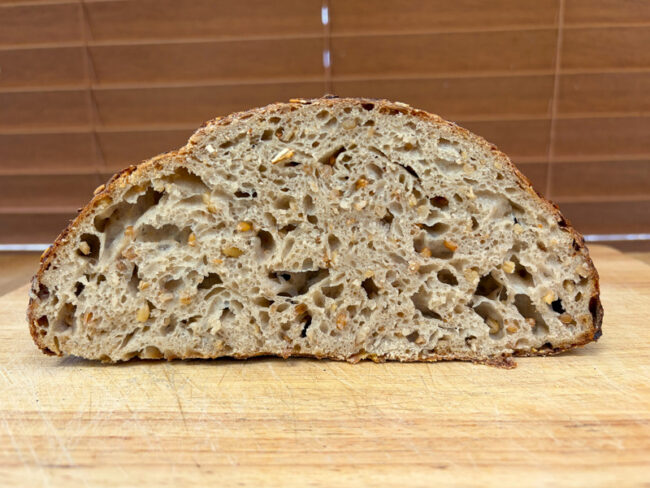
Although the porridge bread recipe was fairly straightforward to develop, there was another challenge: fitting it into Razava’s intricate baking schedule, which includes several different types of breads as well as pita and bagels.
“[A baking schedule] is like a long list, a breakdown of lots and lots of tasks that each have to happen at a very particular time for everything to add up, in the end, so that when the customer opens up the door at seven in the morning, they’re greeted by this wall of fresh bread,” Zin-Tamir says. “And then once you have that schedule kind of worked out, incorporating new breads into that schedule becomes even trickier.”
Luckily, the porridge bread fit into the schedule. When it debuted last summer, it was only available on Friday and Saturday; this past spring, it became a regular offering due to customer demand.
Zin-Tamir mentioned that one of the goals with the porridge bread was to offer a product that wasn’t available at other local bakeries, and he’s definitely succeeded. The texture is surprisingly light and tender, almost bouncy, but there are also little bits of grain throughout that lend a hearty chew. Flavor-wise, it’s hard to pin down, with a pronounced tang and wholesome earthiness but also a slightly sweet, delicate nutty quality.
Razava’s website lists potential porridge bread toppings: a runny egg and flaky salt, smoked fish, honey and butter, tahini and date syrup. I always intend to give one or two of them a try, but I instead find myself eating slice after slice straight up. It’s a bread that’s complex enough to eat on its own and feel like you’ve savored an entire meal. I’ve long maintained that if I could eat only one thing for the rest of my life, it would be bread, usually imagining a baguette, a sourdough boule, or maybe the dense rye bread I fell in love with on a trip to Iceland. Now I think it would be Razava’s porridge bread—there’s enough nuance that I could enjoy it for decades.
“The porridge bread is very much aligned with our overarching philosophy at Razava, and what my overarching philosophy has always been,” Zin-Tamir told me. “I went through the article that you wrote about Bakery on 22nd Street, and I said the same thing that I’m going to tell you now. The bread is all about the grain. What porridge bread is, essentially, is just making it even more about the grain than it already is.”
Razava Bread Co., 685 Grand Ave, St Paul, 763.338.0853, WED-SAT 7am-4pm SUN 8am-3pm