

PHOTOS BY BECCA DILLEY / ART BY WACSO (FILE)
“It doesn’t matter if we are Latino or white Anglo-American or Somali or Black. We’re all affected by the military actions that the president is taking against, collectively, everybody here in Minnesota,” says Basim Sabri. Sabri owns and operates Minneapolis’s Karmel Mall and Plaza Mexico, respectively the largest Somali and Mexican shopping centers in the state.
Although everyone may be affected, some neighborhoods are hit much, much harder than others. The impact of Operation Metro Surge is especially noticeable on East Lake Street, a vibrant cultural corridor that’s home to the Midtown Global Market, Latino marketplaces Plaza Mexico and Mercado Central, and dozens of immigrant-owned restaurants, bakeries, and shops. It’s the kind of place where a halal butcher has a “se habla español” sign in the window and you can eat your way halfway across the globe in the space of a few blocks. That diversity has made the neighborhood a target for immigration enforcement that observers have described as often scattershot, arbitrary, violent, and/or poorly documented.

“What we’re seeing is that the fear and uncertainty in the community is affecting people’s ability to show up, whether it’s customers or staff,” says Matt Tell, executive director of Friends of Global Market, the nonprofit entity that supports the Midtown Global Market. “For a lot of people, they just feel safer to be at home, and it’s really affecting traffic, which, of course, affects sales and the livelihood of businesses along the Lake Street corridor and at Midtown Global Market.”
“Plaza Mexico is 99.9 percent shut down right now,” says Sabri. “I mean, it’s open, but it’s like a ghost town…I have tenants who are U.S. citizens, but they don’t have any workforce and none of the clientele are coming.”
A MAN-MADE, POLITICALLY MOTIVATED ECONOMIC PANDEMIC
Tell compared the current low traffic levels at the Midtown Global Market to the COVID pandemic. “It’s a tough situation, so we have to keep pushing and we’re meeting every day to brainstorm different ideas and work with our vendors,” he says. Possible approaches include promoting income streams that don’t rely on foot traffic, such as online orders and catering. He encourages the community to support small local businesses, including those at the Midtown Global Market, if they’re able to do so safely. “Midtown Global Market is a hub for Minneapolis and the community—we want to keep offering that up and be there for everybody,” he says.

Similarly, Sabri encourages the community to patronize Latino-owned businesses along Lake Street, noting that he’s observed more visible support of the Somali community and doesn’t want Latinos to be overlooked.
In part to get a sense of the situation on the ground and in part to do my very small part to support immigrant-owned businesses, I spent several hours on East Lake Street on a recent weekday. I had hoped to start at Mama Safia’s Kitchen, but when I arrived I discovered that the Somali eatery has cut back hours to 1:00 p.m. to 8:00 p.m. Unfortunately, shortened hours and unannounced closures have become a fixture on Lake Street—diners should be flexible and have an alternate option (or two or three).

My backup plan was the Midtown Global Market, where I stopped by Mapps Coffee & Tea, which is owned by Turkish immigrants Erdogan and Yildiz Akguz. The direct-trade coffee is roasted in-house, and the extensive menu of specialty drinks can hold its own against any chain coffee shop. My small cinnamon latte ($5.88) balanced assertive warm spice notes, a solid coffee backbone, and sweetness—it reminded me of dipping a cinnamon cookie in a cup of espresso.
The market’s central seating area has decent wifi, plenty of tables, and comfortable chairs, so I joined a handful of fellow remote workers for an hour or so. The lunch crowd started filtering in just after 11 a.m., people in scrubs and office casual attire mingling with construction workers. I had hoped to get tacos—it was a Tuesday, after all—but both El Taco Torro and Salsa a la Salsa were closed. Instead, I ordered drunken noodles with tofu ($12.96) from Sabbai Cuisine, which offers a menu of Cambodian and Thai fusion dishes. The generous portion of noodles was loaded with crisp-tender broccoli and carrots, pleasantly chewy tofu, and tender bits of egg that was clearly freshly scrambled. I opted for a three (or medium) heat level, which was tingly but more aromatic than searing—heat lovers should probably bump it up a notch.
A LOOMING PRESENCE
Even when they’re not physically present, ICE feels like a constant threat on East Lake Street. “Everyone is welcome here! Except I.C.E.” signs were taped to nearly every business door, often alongside posters promoting the January 23 statewide shutdown protest. On a prominent street corner, a woman stood guard with a whistle, bundled up against the single-digit temperatures. At Mercado Central, the door was locked, an elderly man keeping watch to open it for customers. As Sabri had noted, Plaza Mexico was eerily quiet, the winding corridors lined with dozens of shuttered storefronts.
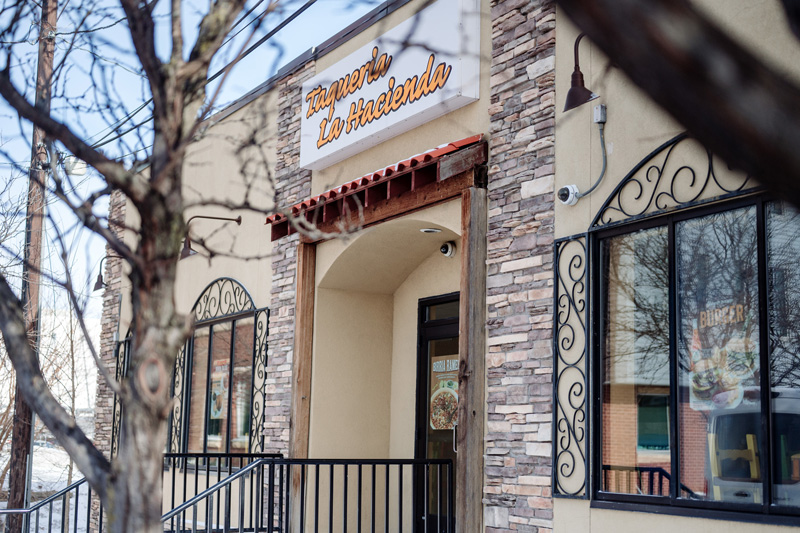
There were also moments of hope. At Mawadah Cafe, the Somali owners had posted a statement on an easel by the cash register, thanking the community. “When our community stands together, we always move forward with hope and strength,” it read in part. “Your support reminds us that love and community will always be stronger than hate.” My Somali shaah ($3) and Bischoff cake ($5) were a much needed mood boost, the complex spices of the tea complementing the tiramisu-like layers of Bischoff cookies and whipped cream. The cafe has a chic, welcoming vibe, with potted plants, board games, and a kids’ corner with toys and art supplies.

I had hoped to buy some treats for my book club meeting that evening, but I had nearly given up after walking by four shuttered bakeries. Panadería Ecuatoriana Charito was open for business, although the door was locked—the man behind the counter hustled to open the door once he spotted me. His spoken English was limited, and my Spanish skills are non-existent, but the language of commerce and carbs is universal. I loaded up a tray with an assortment of cookies and pan dulce ($0.25-$2 each) and after he had carefully bagged them up, he said something into his phone and held it up for me to see.
“Thank you for supporting Latinos,” read the text in the translation app.
I wish that I had pulled out my own phone and typed something into Google Translate like, “Thank you for your hospitality, Latinos and all immigrants make this city so special.” But in the moment, all I could think to do was smile and say one of the few Spanish words I know: gracias.
He smiled back at me. Once I was back on the sidewalk, I heard the click of the door locking behind me.