
Editor’s Note: Hien Deli is now closed.
You can’t swing a dead cat on Eat Street in Minneapolis without hitting a decent South Vietnamese pho joint these days. Among the dozen or so Vietnamese places along Nicollet Avenue, Hien Deli (2624 Nicollet Ave., Minneapolis) is the only restaurant reppin’ it for Central Vietnamese cuisine. Even the whitest of white bread Twin Citizens have tried fried spring rolls or banh mi at least once, but dishes such as banh bot loc la (shrimp-and-rice flour cakes steamed in banana leaves) and banh beo (the esteemed subject of this article) remain largely under the radar.
Although it pains me to invoke the “Asian fusion” hydra, it may be helpful to view Central Vietnamese food as a kind of Vietnamese tapas. While South Vietnamese food may be famed for its unpretentiousness, the Central region’s traditional dishes all come in fairly small portions and feature a painstaking devotion to presentation. Like Kyoto and Paris, the city of Hue is widely recognized as ground zero for the nation’s haute cuisine.
However, this is all speaking relatively. In Hue proper, elegant dishes that one wouldn’t be surprised to find at WD-50 or 112 Eatery are usually consumed on children-sized plastic tables in settings that would give your average American health inspector an aneurysm.
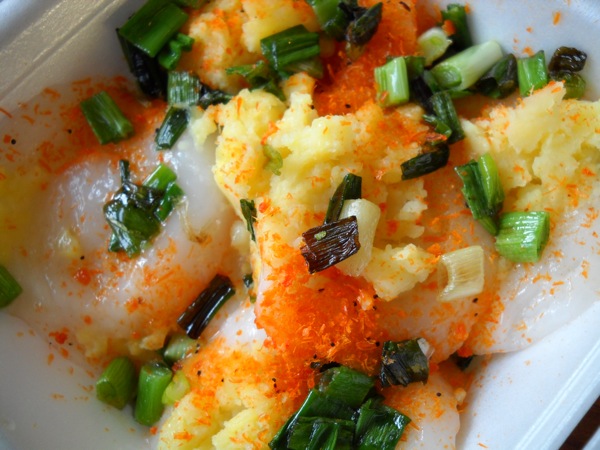
The most addictive dish in Hue’s pantheon of small plates is banh beo. The cakes’ dough, which is made of rice flour and water, is steamed in individual ceramic dishes in small batches. Though it may vary from place to place, the typical banh beo is about two inches in diameter. The bland, jiggly rice cakes are then topped with a punchy mixture of pureed mung beans, ground shrimp, and sauteed scallions. Presentation varies, as well: The cakes can be served with or without the tiny saucers in which they were cooked.
Each cake is good for maybe one or two bites — it suffers just a quick dip in some fish sauce, and then it’s gone. Eating them is a repetitious exercise in ecstasy and grief, and will perhaps evoke painful childhood memories of sitting alone in the dark with a bag of Cheetos while waiting for your workaholic parents to come home. Or not, whatever.
At Hien Deli, one may purchase 10 pieces of banh beo for the absolutely criminal price of $3. Since the restaurant is one of the few on Eat Street that hasn’t been blessed by the yuppie crowd, non-Vietnamese speakers may have some difficulty placing their orders, but press on! Hien’s attentively prepared Central Vietnamese cuisine is definitely worth the initial awkwardness.
Good article. I would love to see more articles on Vietnamese and Korean dishes. If I was stuck on a desert Island and could only cook in two styles…these would be it.
“Swinging a dead cat” is a poor choice of words when discussin Asian street food. Just sayin’
Whatever dude, only North Vietnamese eat cats!
Being that I’ve been involved in a long-time love affair with VN cuisine, and particularly enjoy “tappas” time items, I found the article to be passionately written by someone who has style and the “inside” taste. While petting my own cat, I apologized to her for the initial phrase. But, the author has been forgiven.
I must try this restaurant as soon as I return to Minneapolis. there is such great VN food there. appetizing article.. thanks.
Wow. Swinging a dead cat. So what gave you the idea that a food review was the best place to abuse imagery? Or was this the first thing that popped into your head when you thought about Vietnamese restaurants?
“Swinging a dead cat” is a common expression in English for “short distance,” just like “stone’s throw,” so it probably wasn’t intended as a comment on Vietnamese food. The writer – and editors – probably didn’t think through the possible interpretations.
Having said that, now I’ll comment on the actual food. Not being afraid to try inexpensive restaurants that seem to show promise at first glance, Hien is one of my lucky finds from a few years back. Before that, I lucked into Quang when it was a little place across the street from its current, large and famous spot.
I love Hien, and I keep coming back when I’m in this part of town. I love trying things there that I haven’t eaten before. I don’t think I’ve ever had something I didn’t like.